Monday, June 27, 2022

Review: Impossible Times trilogy

 Impossible Times trilogy by Mark Lawrence

☆☆☆☆☆

Science Fiction

These books are about time travel plus Dungeons and Dragons. It doesn’t get nerdier than that. The three short books are fast-paced and jam-packed.

#1. One Word Kill

I was intrigued right from the beginning all through to the end. It was a thoroughly enjoyable adventure. I was hoping for more at the end, but then I found out there will be a sequel.

The book is set in Britain and written with British punctuation and spelling with a little American style. It’s an odd combination. Some occasional strong language.

#2 Limited Wish

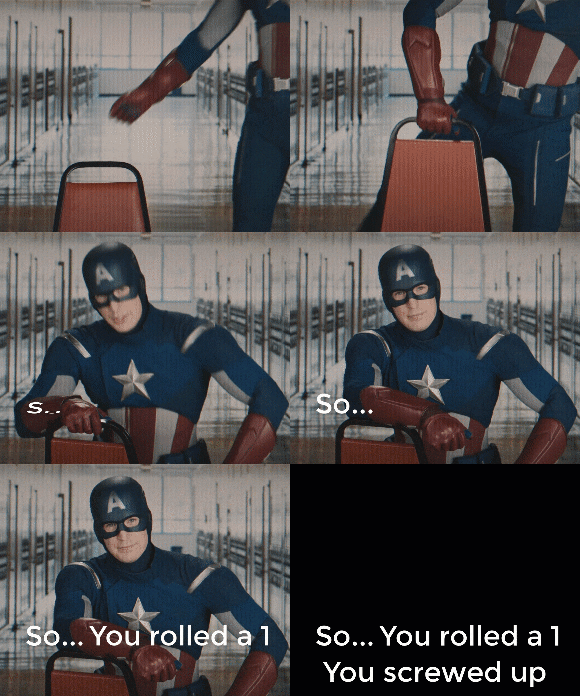
Nick is at Cambridge University at 16 and finds the laws of physics are kind of quirky around him. For instance, he keeps rolling 1s in D&D.

He still has to invent time travel and fight cancer, though. Okay, it’s pretty nerdy.

The D&D scenes were very interesting; that’s skilled writing to accomplish that. I loved how it paralleled real life. The ending was really exciting. All aspects of the story were just great: characters, setting, pacing, plot. The story was so immersive. (The descriptions of Nick feeling sick were so visceral; it reminded me of all the times I was throwing up in public from a migraine attack.)

It was so good: funny, suspenseful, heartbreaking; perfect pacing and great storytelling. I seriously don’t have anything to criticize.

Mother had very new-fangled ideas about nutrition and refused to buy me Golden Nuggets, on the grounds that they were 96 per cent sugar. Which, oddly, was my main argument in favour of them. Instead she bought joyless boxes of Shredded Wheat, the contents of which I conducted mechanical stress tests on by loading them with as much sugar as they could bear. “Do leave some milk in the bottle, dear!” Mother admonished as I attempted to drown the evidence.

There is an unwritten rule of tube travel, understood instinctively by every Londoner from young schoolboy to doddering ancient. You pretend it’s not happening. You pretend that half a dozen strangers are not squeezing against you to a degree that is usually reserved for orgies. You pretend that your nose is not inches from the unwashed armpit of a beefy man, that a young woman’s hair is not tickling your face, that you did not step on that person’s foot. 

#3 Dispel Illusion


This final book covers several time periods. First, Nick and the gang are in 1992, when time travel is getting under way as a feasible technology. In 2011, Nick seems himself turn into Demus and has to face the fate waiting for him in 1986. And then ... Read and find out. There is a lot of suspense and humor and surprises and a cool D&D game. Really, this series is just about perfect.

I also love how time travel works in the series. In most stories, you vanish from one time and show up in another. But I’ve always believed that you wouldn’t just disappear from space when traveling through time. We naturally travel through time and space as it is. We have more control over our movement through space. So if you could have more control over moving through time, you’d have less control over movement through space but never disappear from either. Lawrence has had this same thought, and I really appreciate it.

I wanted that back. I wanted those days back. And even though I was standing in them, letting them flow by me hour after hour, I knew that could never happen. We get one shot. However you play it out. Fast forward it, rewind, it’s still the same: a single shot.

The universe doesn’t care about time. We care about time. Because we remember.

Monday, January 10, 2022

Odd Spellings: Peek, Peak, Pique

This set of homophone pairs often leaves out pique, which often gets spelled like one of the others. 

Peek: to look while trying not to be seen

Peak: the top (of a mountain or career, for instance)

Pique: to stir, usually in “pique my interest.”


Trick to Remember:

Peek has two eyes to see with.

Peak is first or best, like the letter A.

Pique is to get you interested in something quirky.

Monday, November 15, 2021

Review: Lux by Brandon Sanderson & Steven Bohls


☆☆☆

Science Fiction — Science Fantasy — Urban Fantasy

This has Sanderson’s fingerprints on it but not his soul. The original Reckoners series is far superior. This book has some really good moments and others that are just off.

The story takes place in Texas. Lux is a floating city in the sky (because why not) that used to be Sugarland. Four Epics run it: Lifeforce, Languish, Stormcloud, and Wingflair. Lifeforce makes everybody there immortal, Wingflair keeps in floating, Stormcloud makes the atmosphere livable, and Languish can only dampen others’ powers. A small group of Reckoners is determined to take them down. But compared to a lot of other cities, Lux really isn’t THAT bad of a place.

I wasn’t crazy about most of the characters. They didn’t feel fully developed. They were more tropes than people, and if any of them died, I wouldn’t or didn’t care. It switches from first person with Jax to third person with other characters, including Epics. Languish was probably the most interesting to me.

So far this is available only on Audible. The narrator is pretty good except when doing women’s voices. He makes their voices super nasally, and I swear Paige’s voice changes half-way through. This is a result of trying too hard to represent the opposite gender. Dude, just talk.

The pacing is kind of all over the place. Some scenes are very drawn out; others are rushed. We spend so much time at the beginning with Jax’s childhood training that by the time he was ready to confront Epics, it felt like the book was about to be over. There are some serious clichés in here, too, like the fridging of Jax’s brother.

I was confused on a few things. I wasn’t sure why Lux had to be in the air. I guess to keep moving so they could pillage everywhere on the ground? It seemed like a lot of effort for a small reward. And when the city still floats even any Epics using powers. In the original series, it was stated that Epics could only be killed by their personal weaknesses, but here they’re saying if you can blow them up, that’s just as good.

I had a lot of issues with the science. It was wrong so often! I’ll accept mumbo jumbo for sci fi stuff, but basic science has to be right. I mean, this is stuff that is common knowledge. Here are three things that irked me: (These are minor spoilers.)

1. Objects fall at the same rate (barring air friction): In the book, the city falls a few feet, so all the objects also fall. In the book, the heavier, bottom objects fall faster than the lighter objects on top of them. This is wrong. I tried it at home just to be sure. (See here for the math behind it.)

2. You have to draw blood from a vein: In the book, characters just stick a syringe anywhere in the skin and suck blood like magic. No tourniquet, no special needles, nothing. You might suck up a drop of blood this way, but it won’t be good for anything.

3. Computer tech is very specialized: In the book, we have the All-Knowing Hacker/Tech Dude. He is good at everything to do with computers. No area is beyond his knowledge. This is impossible and completely unrealistic. It’s like expecting a concert violinist to also be an expert in all the other instruments, or a star football player to also be a star baseball, basketball, and hockey player.

Monday, November 8, 2021

Writing Advice: Proactive Characters

At the beginning of your story, your characters may be reacting to a bunch of stuff happening to them: They lost their job, their house got bombed, they were wrongfully jailed, aliens abducted them, whatever. You just throw stuff at them and watch them struggle. But after the first half, your main characters need to do more than react to weird stuff. They need to take charge of their lives and stop reacting. This makes the story much more interesting.

Look at Star Wars with Luke: First he’s just reacting as he works on his farm with new droids. Then he makes a decision to go to Alderaan. He’s more proactive now but still inexperienced. At the end, he joins the X-Wing fighters to assault the Death Star—a very proactive decision. The story is much more satisfying because of it.

A plot in which the characters merely react doesn’t make a great story, and it doesn’t create character development. So if you find yourself floundering in the middle of the story, let your characters take charge of their situation. You can still throw stuff at them, but they should start taking back control.

Wednesday, August 18, 2021

Usage: Reluctant Vs. Reticent

 This issue has been popping up more and more lately. Again, these words are not interchangeable.

Reluctant is well understood. It means to resist doing something or to do something unwillingly.

But reticent is very specific. It means hesitant or unwilling to speak, not reluctant in general.


Trick to Remember

Reluctant is similar to hesitant.

Reticent is related to silence (-cent, s-enc).

Wednesday, March 31, 2021

Review: Strangers

Strangers by Michaelbrent Collings

☆☆☆☆
Horror

This is a someone-in-your-house-is-going-to-kill-you horror. The prologue is police finding a house (with bodies and a single insane survivor) after our crazy psychotic villain has finished with them. 

The main story focuses on the villain’s next target. For some reason my brain could not figure out the link between the two; I re-read the beginning several times before the blatantly obvious explanation found me.

The villain targets families with secrets. First he messes with them psychologically, then pressures them to confess or be killed. It’s all very creative and quite creepy and sometimes gruesome. 

It’s incredibly suspenseful, and the chapters are very short, so it’s very easy to keep going (“One more chapter … “one more chapter” … ) and stay up all night reading. The problem is I cannot do this without getting a massive migraine. As it was, I spent the whole weekend with migraines because I stayed up too late anyway. (And I know Michaelbrent gets killer migraines.)

A must if you enjoy horror or suspense.


For a version of the review with gifs, check here.


Language: Some occasional uses of s---

Sexual Content: General description of a striptease

Violence: Plenty, some of it gruesome